
Can Overseas Directors Use a Virtual Office Address in the UK?
For overseas directors, the UK often looks deceptively simple.Company formation is fast. The regulatory framework is familiar. English is the working language. And setting up a virtual office address can feel like the final, straightforward step in establishing a UK presence.But “can you use a virtual office address?” is not really the right question.
The better question is: can you use one without creating future compliance, banking, or credibility issues?Because while the answer is technically yes, the reality is more nuanced and that nuance is where many overseas directors get caught out.
Why Overseas Directors Are Drawn to Virtual Office Addresses
From the outside, the appeal is obvious:
- No need to lease physical office space
- Immediate UK presence
- Lower setup and running costs
- Flexibility for remote or international management
For directors based outside the UK, a virtual office can act as a bridge allowing the company to operate, trade, and correspond in the UK without relocating people or infrastructure.Used correctly, this can work very well. Used casually, it can create complications that don’t surface until much later.
The Legal Position: Is It Allowed?
Yes overseas directors can use a virtual office address in the UK.UK company law does not require directors to be UK residents. It also does not require a company’s registered office to be a physical workspace used daily by directors or staff.
What the law does require is that the address:
- Is a genuine, serviceable UK address
- Can reliably receive official correspondence
- Is suitable for use on public records
Companies House accepts virtual office addresses, provided they meet these criteria.So from a purely legal standpoint, there is no prohibition.Where things become complicated is how that address is used and how it aligns with the wider structure of the business.
Where Overseas Directors Often Misunderstand the Rules
Many overseas directors assume that if a virtual office address is accepted at registration, it must be acceptable everywhere else too.That assumption causes problems.
Different institutions assess addresses differently. What passes at Companies House may raise questions with banks, payment processors, accountants, or tax authorities.Compliance is not a single checkpoint. It’s a system of overlapping expectations
How to Open a UK Business Bank Account as a Non-Resident
For overseas directors, opening a UK business bank account is often the first real test of a virtual office setup. Banks don’t just check that your virtual office address exists they want proof of operational credibility, transparency in management, and a clear paper trail for compliance purposes.Many directors assume that having a registered UK address is enough. In practice, banks will also review:
- Who controls the company and where decisions are made
- How mail and statutory correspondence are handled
- Whether the business structure aligns with UK regulatory expectations
Overseas directors who skip these checks often encounter delays or account rejections. This mirrors the challenges we discuss in our guide on common compliance mistakes when using a virtual office address particularly around mail handling, address verification, and transparency.
The Registered Office vs. the Place of Management
One of the most important distinctions for overseas directors is the difference between:
- The registered office address, and
- Where the company is actually managed and controlled
A virtual office address can serve perfectly well as a registered office. But it does not, by itself, determine where decisions are made.
This matters because management and control affect:
- Tax residency
- Banking risk assessments
- Regulatory scrutiny
If all directors are overseas and all strategic decisions are made outside the UK, the virtual office must not create a misleading impression of UK-based management.Clarity matters more than optics.
Banking: Where Most Overseas Directors Face Difficulties
Banks are often where virtual office strategies are tested hardest.
UK banks don’t just look at whether an address is valid. They assess:
- Who controls the company
- Where directors are based
- Whether the UK presence has substance
- How mail and communication are handled
A virtual office address used transparently is usually fine. One that appears to mask the absence of UK operations is not.This is why some overseas directors experience delays or rejections during account opening even though their company is perfectly legal.
Transparency Matters More Than Presence
One common fear among overseas directors is that using a virtual office might look “less legitimate”.In practice, regulators care far more about transparency than physical presence.
Problems arise when:
- Clients believe the company operates from the UK when it doesn’t
- Call answering services imply on-site staff
- Documents suggest UK-based management that isn’t real
A virtual office should support clarity, not create ambiguity.When expectations are set correctly, virtual arrangements are rarely criticised.
Tax Considerations Overseas Directors Should Not Ignore
Using a UK virtual office does not automatically make a company UK tax resident but it can contribute to the overall picture.
Tax authorities look at:
- Where strategic decisions are made
- Where directors habitually operate
- Whether the UK address reflects real activity
For overseas directors, the key is consistency. If the company is genuinely managed abroad, the virtual office should not suggest otherwise.This is an area where professional advice is often essential, particularly for directors operating across multiple jurisdictions
Virtual Offices and Long-Term Credibility
A virtual office address that works at launch may not be suitable forever.
As the business grows, overseas directors often encounter new expectations from:
- Investors
- Auditors
- Regulators
- Enterprise clients
At that stage, questions shift from “is this allowed?” to “is this appropriate?”A virtual office can remain part of the structure but it may need to evolve alongside the business.
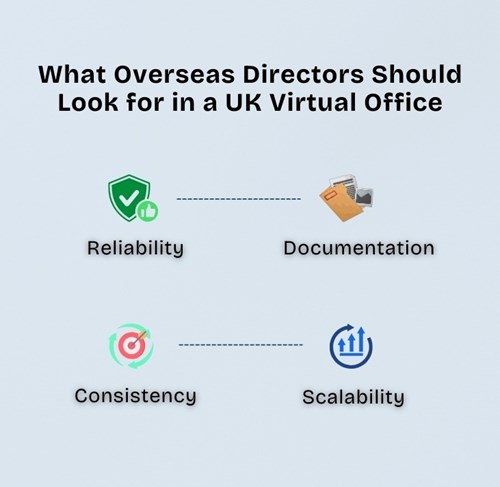
What Overseas Directors Should Look for in a UK Virtual Office
Rather than focusing on price or postcode alone, overseas directors should assess:
- Reliability: Is mail handled systematically, not casually?
- Documentation: Can the provider support verification requests?
- Consistency: Will the address align with bank, tax, and legal records?
- Scalability: Can the setup adapt as requirements increase?
Providers that design their services with overseas directors in mind such as IBC typically prioritise compliance, clarity, and long-term usability over surface-level features.
The Role of Location: London vs Regional UK Addresses
London remains popular, but it isn’t always the best choice.
For many overseas directors, regional UK cities offer:
- Lower scrutiny due to less address saturation
- Better alignment with specific industries
- Fewer reputational assumptions
What matters is not prestige, but plausibility. The address should make sense for the business model and remain defensible under scrutiny.
When a Virtual Office Is the Right Choice
For overseas directors, a UK virtual office works best when:
- The business is genuinely international or remote-first
- Management structures are clearly documented
- Communication is transparent
- Compliance responsibilities are taken seriously
In these cases, a virtual office is not a compromise, it's an efficient solution.
When It Becomes a Risk
Problems usually arise when a virtual office is used to:
- Create a false impression of UK operations
- Avoid engaging with compliance obligations
- Delay decisions about proper structure
At that point, the address becomes a liability rather than a tool.
Final Thoughts: Yes But Use It Properly
So, can overseas directors use a virtual office address in the UK?
Yes. And many do so successfully.But success doesn’t come from the address itself. It comes from how thoughtfully it’s integrated into the wider business structure.For overseas directors, the safest approach is not to ask, “Is this allowed?” but “Would this still make sense if someone examined it closely?”
When the answer is yes, a virtual office stops being a risk and becomes exactly what it should be: practical, professional, and reliable