
Does Your Business Address Build Customer Trust? The Benefits of a Virtual Office
Consider two companies that provide the exact same service at the same cost. Both have teams that are similarly qualified, polished websites, and comparable experience. However, one specifies a residential address in a tiny town, while the other shows a company location in London. Would consumers have a different impression of them before contacting them?
The consumer, the sector, and the kind of service being provided may all influence the response. Even if a company's address is just one aspect of its identity, it can have an impact on people's initial perceptions before they have a chance to see the calibre of its output.
There are associations associated with location. London might imply having access to professional services, a vast commercial network, and domestic or foreign markets. A regional address might convey accessibility, local expertise, and a closer bond with a certain community. Both can influence how a company's business identity is perceived, but neither automatically increases a company's credibility.
This is why a virtual office address London can be relevant to businesses that want to establish a professional presence without renting a permanent office in the capital. The real opportunity is not simply to display a London postcode. It is to use an appropriate business address as part of a wider strategy built around credibility, communication and customer confidence.
Why Does a Company's Location Influence Trust?
Customers rarely have complete information when they first discover a business. Before speaking to its team or reviewing its work, they rely on signals such as the website, company details, testimonials, pricing and contact information.
An address is one of those signals. It helps customers understand where a business is based, how it presents itself and whether its identity appears consistent with the services it offers.
For example, a consultancy targeting large organisations may want to establish a presence in London because many of its prospective clients operate in the capital. A local trades business, by contrast, may build more trust by highlighting its actual service area and community connections.
The address matters because it provides context, not because a particular postcode guarantees quality.
Customers may also use business details to assess whether a company appears established and reachable. If an address is presented clearly, correspondence arrangements are reliable and the company's other information is consistent, the overall impression may be more reassuring.
However, if a business uses an impressive address but provides unclear contact details, makes exaggerated claims or fails to respond to enquiries, the location alone will do little to preserve trust.
The London Effect: What Does a London Business Address Communicate?
London has a distinctive place in the UK's commercial landscape. It is associated with finance, technology, professional services, international trade and a wide range of business networks.
For companies that serve customers across the country, a London address may help communicate an intended connection with this market. It can also make sense for businesses seeking clients who specifically want a London-based service provider or contact point.
A virtual office address London gives eligible businesses an option for establishing a professional address without automatically committing to a traditional office lease.
This can be useful for:
- Startups building their first professional business identity.
- Consultants targeting corporate clients.
- Digital agencies working with businesses in several cities.
- International entrepreneurs establishing an eligible UK business presence.
- Remote-first companies that do not require permanent office space.
The important distinction is between having a London address and operating a business that genuinely serves London customers. An address may support a company's positioning, but it should never be used to suggest that staff, facilities or services exist at a location when they do not.
A credible business explains what its address represents and makes it easy for customers to understand how the company operates.
Does a Prestigious Address Make a Business More Trustworthy?
A prestigious address can influence a first impression, but trust develops through evidence.
Consider a potential customer comparing two web design agencies. One has an impressive central London address but provides little information about its previous projects. The other uses a modest business address but displays detailed case studies, transparent pricing, clear contact information and genuine client feedback.
The second agency may be more convincing because it provides stronger evidence of its capabilities.
This illustrates an important principle: an address can attract attention, but a business must earn trust through its actions.
A professional address is most effective when supported by other reassuring signals, including:
- A well-maintained website with accurate business information.
- Clear explanations of products and services.
- Genuine reviews and relevant case studies.
- Prompt, professional responses to enquiries.
- Transparent terms, pricing and policies.
- Reliable handling of business correspondence.
A virtual office can contribute to this foundation by providing an appropriate business address and, depending on the package, mail handling or other administrative services. It cannot replace the customer experience that ultimately determines whether a business deserves its reputation.
Virtual Office Address London vs Regional Business Address
Choosing between a London address and a regional address is not simply a question of prestige. It is a decision about the market a company wants to reach and the impression it wants to create.
A London address may suit businesses pursuing national or international opportunities. A regional address may be more relevant to companies whose customers value local expertise, proximity or community connections.
The right choice depends on the company's actual business model.
|
Factor |
Virtual office address London |
Regional business address |
|
Brand positioning |
May support a London-focused or national commercial identity |
May communicate regional knowledge and local relevance |
|
Target customers |
Businesses seeking London connections or wider market reach |
Customers concentrated in a particular town, city or region |
|
Customer expectations |
Customers may expect a clear explanation of the business's London connection |
Customers may value genuine local service and accessibility |
|
Expansion strategy |
Can support exploration of the London market |
Can support a focused regional growth strategy |
|
Cost considerations |
Depends on location, provider and services selected |
Depends on the region, provider and services selected |
|
Potential limitation |
May create misleading expectations if the business exaggerates its physical presence |
May be less aligned with a brand targeting customers who specifically seek a London contact point |
|
Best suited to |
Companies with a genuine reason to establish a London-facing presence |
Companies whose market and operations are closely connected to a particular region |
Neither option is inherently more credible. A regional company with excellent service can inspire greater confidence than a poorly managed business with a central London address.
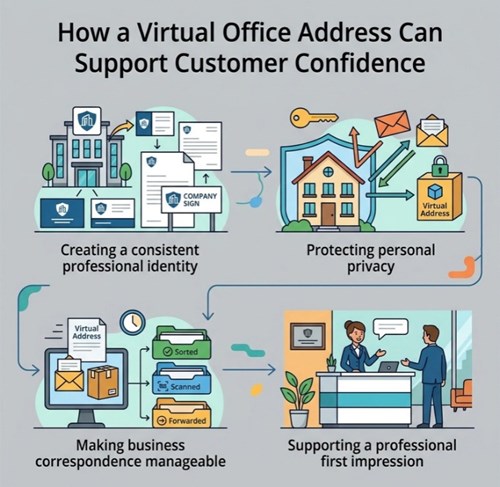
How a Virtual Office Address Can Support Customer Confidence
For remote businesses, the challenge is often to present a professional identity without maintaining premises that employees rarely use.
A virtual office can help bridge that gap by separating the company's public-facing address from the location where its team works every day.
Creating a consistent professional identity
A suitable business address can appear in the appropriate places across a company's website, correspondence and business records. Consistency makes it easier for customers to recognise the business and understand its contact arrangements.
The company should ensure that its address is authorised for the intended use and that its public information accurately reflects the services available.
Protecting personal privacy
Entrepreneurs frequently begin working from home. Using a suitable alternative business address can help separate personal and professional life, particularly when a company needs a registered office or a director needs a public service address.
For UK limited companies, the registered office address is publicly available. A director's service address is also public, while their usual residential address is kept on a private register, subject to the applicable rules.
A virtual office provider may offer relevant address services, but businesses should confirm exactly what is included and ensure that the arrangement meets Companies House requirements.
Making business correspondence manageable
An address is only useful if important correspondence reaches the company. Depending on the service, a virtual office provider may receive mail, notify the business, scan documents or arrange forwarding.
These arrangements can help remote teams manage communications without being tied to a particular workplace.
Before choosing a provider, businesses should check how all relevant correspondence is handled, how quickly notifications are sent and whether additional charges apply.
Supporting a professional first impression
When a potential customer researches a company, the business address forms part of the wider picture. A suitable address, combined with clear contact details and a credible website, can help present the company consistently.
However, professional presentation should never be confused with proof of expertise. Customers still need reliable information about the people, products or services behind the brand.
When a London Address May Not Be the Right Choice
There is a temptation to assume that a London address is always the best option for a growing business. In reality, choosing a location that does not match the company's market can create unnecessary costs or confusion.
A business serving customers primarily in Manchester, for example, may benefit more from a regional address that reflects its commercial focus. A local service provider may need to demonstrate genuine coverage of the areas it serves rather than relying on a prestigious address elsewhere.
Similarly, businesses whose operations require customer visits, stock storage, specialist equipment or licensed premises must assess their physical requirements separately. A virtual office does not automatically provide those facilities.
Before selecting a London address, consider three questions:
- Who are your customers? Identify whether they are based in London, elsewhere in the UK or internationally.
- What does the address communicate? Make sure the location supports your positioning without implying a physical presence you do not have.
- What does your business actually need? Check whether you require a registered office, a service address, a correspondence address, meeting facilities or a physical workplace.
The most suitable location is the one that supports the business's real objectives, not necessarily the one that sounds most impressive.
The Role of Transparency in Building Geographic Trust
Customers are increasingly able to research businesses before spending money. They can review websites, compare providers, check company records and look for independent feedback.
In this environment, transparency is more valuable than simply having an attractive address.
A business using a virtual office should explain its services accurately and avoid presenting an address as proof of a permanent office, local workforce or walk-in facility if none exists.
For example, a remote consultancy can confidently explain that its team works remotely and uses a London business address for appropriate correspondence. There is no need to pretend that every employee works in a central London office.
This clarity can strengthen credibility because customers know what to expect. It also helps businesses attract clients who value the actual service rather than an assumption about the company's premises.
Trust is not created by hiding how a business operates. It is built when the company's presentation matches the reality of its operations.
How IBC Helps Businesses Establish a Professional Presence
For businesses looking to establish a professional address without committing to a traditional office, IBC offers virtual office solutions alongside services such as mail handling, coworking and meeting rooms.
These options can help remote businesses maintain a suitable business presence while choosing the facilities they need for their day-to-day operations. A company exploring London opportunities, for example, can assess whether a virtual office address London arrangement fits its business strategy before committing to more extensive premises.
When evaluating any provider, businesses should review the specific address options, mail-handling arrangements, available facilities and permitted uses. The goal is to find a service that supports the company's genuine needs while keeping its business information accurate and transparent.
A well-chosen virtual office can be part of a professional foundation. The long-term value, however, comes from combining that foundation with dependable service, clear communication and a consistent customer experience.
Building Trust Beyond the Postcode
A business address can influence how a company is perceived, but its significance depends on the wider context. Customers may associate London with commercial opportunity, while regional addresses can communicate local relevance. Both can be useful when they align with the business's identity and target market.
For remote companies, a virtual office address London can offer a practical way to establish a professional presence without the costs of a permanent office. Yet the strongest results come when the address is supported by accurate information, reliable correspondence handling and evidence of genuine expertise.
Businesses should therefore think of location as one part of their trust strategy rather than a shortcut to credibility.
A postcode may shape the first impression. What a company does next determines whether that impression becomes lasting confidence.
Frequently Asked Questions
1. Does a company's address affect customer trust?
Yes, it can influence a customer's first impression by providing context about the business's identity and intended market. However, trust depends on many other factors, including service quality, communication, transparency and customer reviews.
2. Why might a business choose a virtual office address London?
A business may choose a London address to support its professional identity, target London-based clients, manage correspondence or establish a suitable business presence without renting a permanent office. The address should be authorised and used accurately.
3. Is a London business address better than a regional address?
Not necessarily. A London address may suit companies targeting the capital or wider commercial markets, while a regional address may be more relevant to businesses serving local customers. The best choice depends on the company's objectives and customer base.
4. Can a virtual office address make a small business look more professional?
It can contribute to a professional presentation by providing a suitable business address and, where offered, mail-handling services. However, a professional address cannot replace reliable service, clear communication and genuine evidence of the company's capabilities.
5. Can I use a virtual office address as my UK company's registered office?
Potentially, yes. The provider must permit the intended use, and the address must meet the applicable Companies House requirements. It must be an appropriate physical address in the relevant part of the UK, with arrangements that ensure company correspondence comes to the attention of someone acting on the company's behalf and that delivery can be acknowledged.
6. Does using a virtual office mean my business has a physical office in London?
No. A virtual office address does not necessarily mean that the company has a dedicated office or employees working at that location. Businesses should describe their arrangements accurately and check whether meeting rooms or other physical facilities are included in their package.
7. What should I look for when choosing a virtual office provider?
Compare the suitability of the address, permission for its intended use, mail-handling procedures, customer support, contract terms and any additional fees. If the address will be used for company registration, confirm that the provider's service meets the relevant requirements.
8. Is a virtual office suitable for a business that serves customers across the UK?
It can be suitable for remote businesses that do not need permanent premises in every region. The business should choose an address that supports its actual strategy and remember that a virtual office does not automatically provide local staff, customer facilities or permission to conduct every type of business activity.