How to Open a UK Business Bank Account as a Non-Resident
Although opening a UK business bank account as a non-resident may initially seem difficult, it is entirely possible with the correct planning and expert assistance. Because it offers credibility, access to international markets, and a strong financial system, the UK continues to be one of the most reliable business destinations in the world. However, many non-residents have difficulties since UK banks adhere to stringent compliance regulations. A virtual office address becomes crucial because a UK business address is one of the most crucial prerequisites that banks look for. Whether you are a foreign business owner, investor, or entrepreneur, this guide will bring you through every step of the process, from eligibility and documentation to selecting the best bank and avoiding typical pitfalls.
By the end of this article, you’ll understand exactly how to open a UK business bank account as a non-resident and how professional services like IBC can simplify the process.
Can Foreigners Open a Business Bank Account in the United Kingdom?
Although it is more regulated than for UK citizens, non-residents can create a business bank account in the UK. UK banks must abide by stringent know your customer (KYC) and anti-money laundering (AML) laws, which are applicable to both residents and non-residents. In terms of banking, a non-resident is someone who:
- Does not reside in the UK permanently
- Is not a tax resident of the United Kingdom
- Owns or runs a business registered in the UK from overseas
Cross-border risks make banks more cautious when evaluating non-resident applicants. This merely means that your application needs to be transparent, well-prepared, and compliant with UK banking rules; it does not suggest that rejection is certain. A UK-registered business, transparent business operations, and a trustworthy virtual office address greatly increases approval chances.
Why UK Banks Require a UK Business Address
UK banks almost always require a UK business address as part of their verification process. This is not just a formality it’s a legal and compliance requirement.
Banks use a UK address to:
- Verification the legitimacy of the business
- Confirm regulatory jurisdiction
- Conduct compliance checks
- Send official correspondence
Many non-residents make the mistake of using a foreign address or a residential address that banks consider unsuitable. This often leads to delays or outright rejection.
A virtual office address solves this issue by providing a legitimate, bank-acceptable UK address without requiring physical presence in the UK.
Many non-residents choose a virtual office in London to enhance credibility and meet UK banking requirements.
How Does a Virtual Office Address Help? What Is It?
A professional UK business address supplied by a licensed service provider is known as a virtual office address. It can be applied as:
The registered office of your business
A bank and HMRC correspondence address
A formal address for correspondence in business
A virtual office address has various benefits for non-residents:
- Principal Advantages complies with UK banking regulations
- increases the credibility of businesses
- preserves individual privacy
- does away with the requirement for real office space
- The majority of UK banks and EMIs accept
Contrary to common myths, a virtual office address is completely legal in the UK when provided by a compliant company. Banks prefer professionally managed addresses because they are easier to verify and align with regulatory standards.
Documents Required to Open a UK Business Bank Account
Preparing the correct documents is crucial. Missing or incorrect paperwork is one of the top reasons applications are rejected.
Personal Documents
- Valid passport
- Proof of residential address (utility bill or bank statement from home country)
- Date of birth and nationality information
Business Documents
- Certificate of Incorporation
- Memorandum & Articles of Association
- Shareholder and director details
- Business activity description
- Virtual office address confirmation letter
Some banks may also request:
- Business plan
- Expected transaction volume
- Source of funds explanation
Having these documents professionally organised improves approval speed.
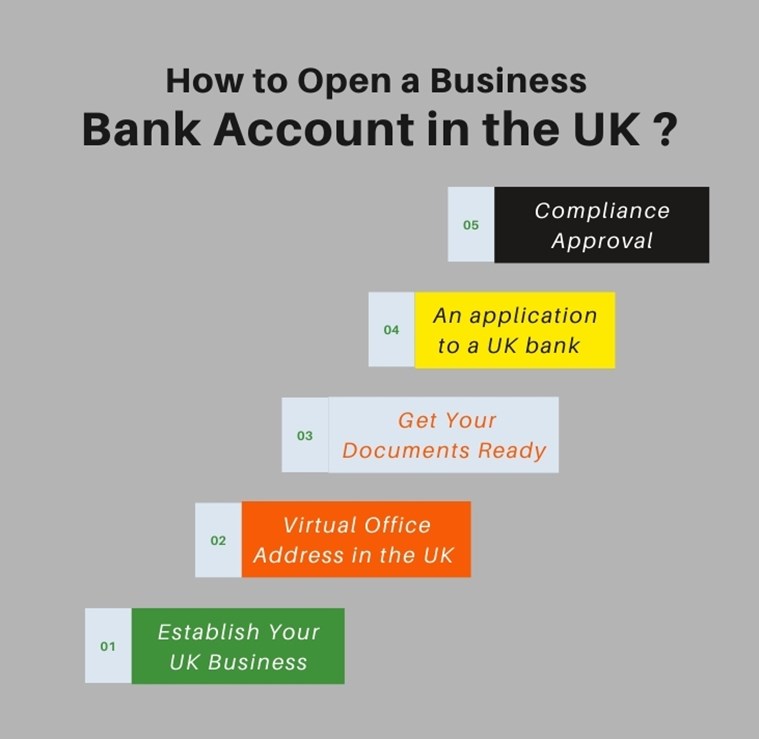
How to Open a Business Bank Account in the UK:
Step 1: Establish Your UK Business
Your business needs to be registered with Companies House before you can apply for a bank account. A Private Limited Company (Ltd) is the most typical form. A virtual office address is usually utilised in the UK, where your registered office address must be.
Start UK company as non resident is the first and most important step before applying for a business bank account.”
Step 2: Obtain a Virtual Office Address in the UK
Select a qualified supplier who provides:
- Addresses that banks accept
- Services for managing mail
- adherence to UK laws
Quality is important since banks frequently check the address supplier.
Step 3: Get Your Documents Ready
Verify every document:
- Exactly match the firm records are precise and current.
- Clearly describe business operations.
- For banks, inconsistencies are a warning sign.
Step 4: Submit an application to a UK bank or EMI
You may submit an application via:
- High-street financial institutions
- Online banks Institutions of Electronic
Money (EMIs) EMIs are frequently more flexible for non-residents, particularly when utilising a virtual office address.
Step 5: Verification and Approval of Compliance
Banks will carry out:
- Verification of identity
- Verification of addresses
- Evaluation of business activities
Depending on the organisation, approval processes can take a few days to several weeks.
Top UK Banks and Non-Resident EMI Choices
Banks on High Streets
Although they typically have more stringent requirements and longer clearance delays, traditional banks offer excellent trust.
EMIs and Digital Banks
For non-residents, digital choices are frequently more appropriate because
- All applications are available online.
- Quicker onboarding
- increased acceptability of virtual office addresses
Your target audiences, transaction volume, and business goals will determine which choice is best for you.
Common Causes of Non-Resident Application Rejection by UK
Banks You can avoid rejection by being aware of the reasons behind it:
- No business address in the UK
- Uncertain or dangerous business operations
- Inadequate documentation
- Inconsistent data
- Inadequately described funding source
These risks are greatly decreased by using a professional virtual office address and professional advice.
How IBC Helps Non-Residents Open UK Business Bank Accounts
IBC specialises in helping non-residents establish and manage UK businesses successfully.
Our Services Include
- Professional virtual office address solutions
- Bank-friendly address documentation
- Support with UK company formation
- Guidance through the banking application process
We understand what UK banks look for and help position your application for the highest chance of approval.
Frequently Asked Questions (FAQs)
If I don't live in the UK, can I still create a business bank account there?
With the appropriate paperwork and a working virtual office address, non-residents are able to open accounts.
Is it permissible to use a virtual office address in the UK?
Yes, as long as the service provider is in compliance, it is completely legal.
How much time does it take to open a business bank account in the UK?
A few days to several weeks may pass before approval is granted.
Are virtual office addresses accepted by all UK banks?
While not all banks and EMIs do, a lot of them do, particularly when the address is handled by professionals.
Conclusion
Opening a UK business bank account as a non-resident is entirely possible with the right approach. The key lies in preparation, transparency, and meeting UK compliance standards. A virtual office address plays a crucial role by providing a legitimate UK presence that banks trust.
With expert support from IBC, you can avoid common pitfalls, reduce delays, and set up your UK business banking smoothly and confidently.