Virtual Office vs Physical Office: Costs, Benefits and Which Is Right for Your Business?
Choosing between the best virtual office uk and a physical office can influence how a business spends money, manages its team and prepares for growth. A traditional office provides a dedicated workplace where employees can collaborate, meet clients and manage daily operations. A virtual office, on the other hand, offers services such as a professional business address, mail handling and access to meeting facilities without requiring a permanent workspace.
Neither option is automatically better. The right choice depends on the nature of the business, its budget, the way its employees work and the expectations of its customers.
For startups, freelancers and remote-first companies, a virtual office can provide a professional presence without the commitment of renting premises. Businesses that depend on equipment, regular face-to-face interaction or customer visits may find that a physical office is worth the additional expense.
Understanding the costs, benefits and limitations of both options can help you choose a setup that supports your business today without restricting its future growth.
What Is the Difference Between a Virtual Office and a Physical Office?
A virtual office allows a business to access selected office-related services without renting a dedicated workspace. Depending on the package, these services may include a business address, mail management, telephone answering, meeting rooms and occasional workspace access.
A physical office is a dedicated premises where a business can base its employees and carry out its operations. It may be a private office, a rented commercial unit or a larger corporate workspace.
The main difference is how much physical space the business needs to maintain.
With the best virtual office uk, companies pay for the services they require. With a physical office, they generally take responsibility for the costs associated with occupying and operating a workplace.
| Virtual Office vs Physical Office: A Quick Comparison | ||
|---|---|---|
| Factor | Virtual Office | Physical Office |
| Initial costs | Usually lower | Often higher due to deposits, setup and furniture |
| Monthly expenses | Depends on the selected service package | Rent, utilities, maintenance and other running costs |
| Flexibility | High; services can often be adjusted | Depends on lease terms and available space |
| Employee collaboration | Mainly remote, with optional meeting facilities | Easier for regular in-person teamwork |
| Professional address | Available through eligible providers | The business operates from its own premises |
| Privacy | Can help separate a home address from business correspondence | Can provide a separate business location |
| Equipment and storage | Limited unless additional facilities are arranged | More suitable for equipment, stock and dedicated facilities |
| Client meetings | Meeting rooms may be booked when needed | A regular space is available for meetings |
| Best suited to | Remote businesses, consultants and startups | Teams and businesses requiring physical premises |
The important distinction is not simply whether one option is cheaper. It is whether the business is paying for facilities it genuinely uses.
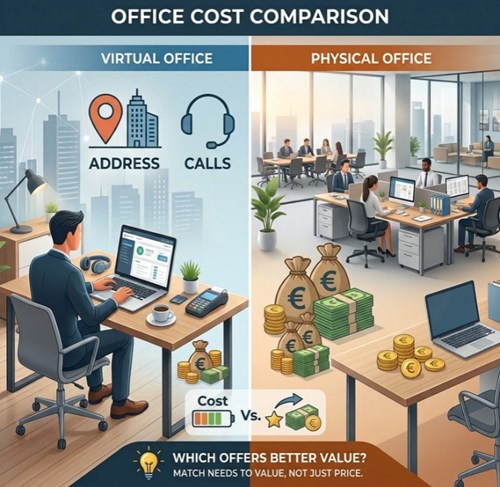
1. Comparing the Costs of a Virtual Office and a Physical Office
Cost is often the first consideration when choosing an office arrangement, particularly for new businesses that need to protect their cash flow.
The cost of a virtual office
Best virtual office UK can reduce the financial pressure of establishing a professional business presence. Instead of renting a complete workplace, a company can select a package based on its requirements.
Typical services may include:
- A professional business address.
- Mail receipt, notifications or forwarding.
- Registered office or correspondence address services, where offered and suitable.
- Telephone answering services.
- Meeting-room bookings or occasional workspace access.
Not every package includes every service. Some providers charge separately for mail forwarding, scanning, telephone services and meeting rooms, so businesses should compare the total cost rather than the advertised starting price.
For entrepreneurs searching for the cheapest virtual office UK options, the lowest price may be suitable if the business only needs a basic address service. However, a company that receives frequent correspondence or regularly meets clients may benefit from a more comprehensive package.
The cost of a physical office
Renting a physical office usually involves more than paying monthly rent. Businesses may need to budget for:
- Deposits and initial rental payments.
- Furniture, computers and office equipment.
- Electricity, heating, internet and other utilities.
- Cleaning, repairs and maintenance.
- Insurance and relevant property-related charges.
- Security, access control and other facilities.
- Employee commuting and workplace expenses.
The exact costs vary by location, office size, lease terms and the type of premises. A small shared workspace may be relatively affordable, while a private office in a major commercial area can require a much larger commitment.
These expenses can be worthwhile when a physical location directly supports productivity, customer service or revenue. However, they can become a burden if much of the space remains unused.
Which option offers better value?
A virtual office will often be more economical for a business that does not need a permanent workplace. A physical office may provide better value when employees use the space daily or when the business needs facilities that cannot be provided remotely.
The most useful calculation is the cost of each option against its actual business value. Saving money is important, but the cheapest arrangement is not necessarily the most suitable one.
2. Flexibility: Which Office Arrangement Adapts Better to Growth?
Business needs can change quickly. A startup may begin with one founder, hire remote employees and later expand into new markets. An established company may also decide to reduce its premises as more employees work from home.
The office arrangement should support these changes rather than make them difficult.
Why virtual offices offer flexibility
A virtual office allows businesses to maintain a professional presence without committing to a permanent workplace. Remote employees can work from different locations, while the business uses external services for correspondence and occasional meetings.
This arrangement can be particularly helpful when a company is testing a new market. For example, a business based outside London may want to attract London clients before deciding whether it needs premises in the capital.
A suitable London virtual office address can support that strategy without immediately taking on the costs of a dedicated office.
Virtual office services can also help companies explore other locations, provided each address serves a genuine business purpose and meets the requirements for its intended use.
Why physical offices can be less flexible
A physical office can make collaboration easier, but it may also involve a lease, furniture, equipment and ongoing operating costs. If the company grows, it may need to relocate to larger premises. If the team becomes smaller, it may find itself paying for unnecessary space.
Short-term licences, coworking memberships and serviced offices can reduce some of these limitations. However, flexibility depends on the agreement and the facilities available.
The practical difference: a virtual office can be a useful starting point for uncertain or changing business needs, while a physical office can offer stability when a team requires a consistent workplace.
3. The Benefits of Choosing a Virtual Office
A virtual office is particularly useful for businesses whose operations do not depend on a permanent commercial premises.
A professional business presence
A suitable business address can help a company present a more established image to clients, suppliers and potential partners. This can be valuable for consultants, freelancers and small businesses operating from home.
A professional address does not guarantee customer trust, but it can support consistent business communications and branding.
Greater privacy
Using a separate business address can help entrepreneurs avoid publishing their home address in places where a business address is required or displayed publicly. This is especially relevant for eligible UK companies whose registered office information appears on the Companies House register.
Businesses must obtain permission to use the address and confirm that it meets the requirements for their intended purpose.
Lower overheads
A virtual office can reduce the need to pay for a permanent workplace, utilities, furniture and maintenance. The money saved can potentially be redirected towards marketing, recruitment, technology or customer acquisition.
Access to additional services
Some providers offer mail handling, telephone answering, meeting rooms and coworking facilities. These options allow a business to access selected professional services without maintaining all the facilities itself.
For example, a consultant might work remotely throughout the month but book a meeting room when meeting an important client.
Support for remote and international businesses
A virtual office can help eligible businesses manage correspondence and establish a suitable UK business address while operating remotely. International founders should check any additional company formation, identity verification, tax, banking and regulatory requirements that apply to their circumstances.
A virtual office does not automatically establish UK tax residence, guarantee a bank account or satisfy every regulatory requirement.
4. The Limitations of a Virtual Office
Although virtual offices offer several advantages, they are not a complete replacement for physical premises in every situation.
Limited access to dedicated workspace
A basic virtual office package may provide an address and mail services without offering a permanent desk. Employees who need a quiet workplace every day may find this arrangement unsuitable unless they have another workspace available.
Less spontaneous collaboration
Remote employees can collaborate through video calls, messaging platforms and project management tools. However, some teams benefit from working together in person, particularly when discussing complex projects, training new employees or solving problems that require close coordination.
Occasional meeting rooms may help, but they do not provide the same experience as a shared workplace used every day.
Mail handling requires reliable processes
Businesses must understand how their provider receives and manages correspondence. Delays, unclear forwarding arrangements or additional charges can create difficulties, particularly when important official documents are involved.
Before signing up, check notification procedures, collection options, forwarding times and the handling of sensitive correspondence.
Not suitable for every legal or operational purpose
An address service does not automatically qualify as a suitable registered office, trading location or premises for every business activity. Companies must check the relevant requirements and the provider's terms.
For businesses that need to store stock, receive regular deliveries, serve walk-in customers or operate specialist equipment, a virtual office alone may not be sufficient.
5. When Is a Physical Office Necessary?
A physical office becomes more valuable when the work itself depends on a dedicated location.
Businesses that need specialist equipment
Companies using machinery, laboratories, specialist technology or other fixed equipment may require premises designed for their operations. A virtual office cannot replace the space, power supply, storage or safety arrangements these activities require.
Businesses with regular in-person customer visits
Some businesses rely on customers visiting their premises. Examples may include certain professional practices, training centres, service businesses and organisations that need a consistent place to meet clients.
In these cases, a physical location can be an important part of delivering the service.
Teams that need daily collaboration
A company with a large team, frequent in-person training sessions or activities requiring close supervision may benefit from a shared workplace. The value of a physical office depends on whether having employees together improves communication, productivity or service delivery enough to justify the cost.
Businesses requiring storage or inventory management
Retailers, distributors and businesses handling physical products may need storage, packing, dispatch and delivery facilities. A virtual office address does not provide these facilities unless they are separately arranged.
Businesses subject to specific premises requirements
Some regulated activities, licences, insurance arrangements or contracts may require a particular type of premises. Businesses should confirm the applicable rules before relying on a virtual office.
In short, a physical office is necessary when the business's work, legal obligations or customer expectations require facilities that an address service cannot provide.
6. Can a Business Combine a Virtual Office With a Physical Workspace?
Yes. A hybrid arrangement can offer a practical middle ground.
A company might use a virtual office for its professional address and correspondence while allowing employees to work remotely. When face-to-face meetings are needed, the business can book a meeting room or use a coworking space.
Another company might maintain a small physical office for its core team while using a virtual office service for a separate business address or an additional market.
This approach can help businesses avoid renting more space than they need while preserving access to facilities when required.
The key is to understand what each service provides. A virtual office, a coworking membership and a private office are different arrangements, and their costs and permitted uses may vary.
7. How to Choose the Right Option for Your Business
Before deciding between a virtual office and a physical office, consider five practical questions.
Does your work require a permanent location?
If employees need specialist equipment, storage or daily face-to-face contact, a physical workspace may be essential. If the work can be completed remotely, a virtual office may be sufficient.
How often will you use the premises?
Estimate how frequently employees and customers would use a physical office. Paying for a full-time space that is rarely occupied may not make financial sense.
What is your realistic budget?
Include setup costs, ongoing charges, additional services, commuting and any potential lease commitments. Compare the total cost over the period you expect to use the arrangement.
What do your customers expect?
Some clients may value face-to-face meetings or require visits to a business location. Others may be entirely comfortable with remote communication and online service delivery.
8. Finding an Affordable Virtual Office in the UK
For businesses that do not need a permanent workplace, an affordable virtual office can provide a professional address and selected administrative services at a lower cost than renting a complete office.
When comparing providers, check the location, the address services included, mail handling, customer support, meeting facilities and contract terms.
Businesses looking for a cheap virtual address UK or cheap business address UK should also confirm whether the service is suitable for their intended use. A low-cost correspondence address may not include registered office services, and a registered office package may not include a separate trading address or meeting facilities.
The best virtual office UK option is therefore not necessarily the cheapest package. It is the service that meets the business's practical requirements at a reasonable overall cost.
Companies targeting specific markets should also consider whether a location is commercially relevant. For example, a virtual office East London service may suit a business focused on East London clients, while a virtual office Cambridge UK address may be more relevant to a company targeting customers in that area.
9. How IBC Can Help Businesses Choose a Flexible Office Solution
IBC provides business support services designed for companies that want a professional presence without automatically committing to a traditional office. Its virtual office options, alongside services such as mail handling, coworking and meeting rooms, can help businesses choose an arrangement that reflects how they actually work.
For a remote-first startup, this could mean using a professional address and arranging meetings only when needed. For a growing company, it may provide a flexible way to maintain business correspondence while evaluating whether dedicated premises are necessary.
Businesses comparing virtual office services London or looking for a suitable virtual office address UK should review the available packages and confirm which services are included. Choosing the right combination can help control overheads without overlooking essential business needs.
Final Thoughts: Virtual Office or Physical Office?
The choice between a virtual office and a physical office comes down to what your business needs to operate effectively.
A virtual office can offer lower overheads, greater flexibility, privacy benefits and a professional business presence. It is often a sensible option for remote teams, consultants, freelancers and startups that do not require permanent premises.
A physical office provides dedicated space, easier in-person collaboration and facilities for activities that cannot be managed remotely. For businesses that depend on equipment, inventory, regular customer visits or specific premises requirements, the additional cost may be justified.
There is also no need to treat the decision as permanent. A company can begin with a virtual office, add coworking or meeting-room access as it grows, and move into physical premises when its operations require them.
The smartest choice is the one that supports your business model, protects your budget and gives you room to grow.
Frequently Asked Questions
Is a virtual office cheaper than a physical office?
A virtual office is generally less expensive when a business only needs an address and selected administrative services. A physical office usually involves rent and additional operating expenses, although the actual costs depend on the location, facilities and agreement.
Can I use a virtual office as my UK company's registered office?
Yes, if the provider permits it and the address meets the applicable Companies House requirements. The address must be an appropriate physical address in the relevant part of the UK, and correspondence must be handled in accordance with the rules.
Can I work from home while using a virtual office?
Yes. Many remote businesses use a virtual office address while employees work from home or other locations. The company should ensure that its address arrangements and business activities comply with applicable requirements.
Does a virtual office include meeting rooms?
Some packages include meeting-room access, while others charge separately or do not offer it. Check the provider's terms before choosing a plan.
When should a business move from a virtual office to a physical office?
Consider moving when the team needs regular shared workspace, the business requires specialist facilities, customers expect in-person access or the cost of repeatedly booking external space becomes less practical than maintaining dedicated premises.
Is a virtual office suitable for every business?
No. It can suit remote and service-based businesses, but companies that require inventory storage, manufacturing facilities, regular walk-in customers or specific licensed premises may need a physical location.