Common Compliance Mistakes When Using a Virtual Office Address
For many modern businesses, the move to a virtual setup feels like progress. Fewer fixed costs. More flexibility. Less friction. A virtual office address fits neatly into that story professional on paper, lightweight in practice.
And yet, most compliance problems linked to virtual offices don’t come from bad intentions. They come from assumptions. From thinking that because an address is “virtual”, the obligations attached to it are somehow lighter. They aren’t.
UK regulators, banks, and counterparties treat addresses as anchors of responsibility. They expect consistency, accessibility, and accountability regardless of how modern your business model looks. When those expectations aren’t met, issues rarely surface immediately. They emerge months later, often at the worst possible moment.
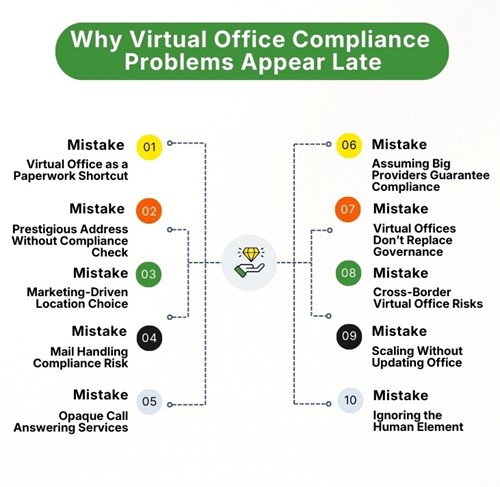
Why Virtual Office Compliance Problems Appear Late
One of the most misleading things about compliance failures is their timing. You register your company. The mail gets forwarded. The phone is answered. Everything appears to be working.
Then, months later, a bank review stalls. A statutory notice is missed. An accountant raises questions. Or a regulator flags your address during a routine check.This delay creates a false sense of security. Many founders assume that if nothing went wrong during setup, nothing will go wrong later. In reality, compliance issues are cumulative. They build quietly, shaped by small oversights rather than dramatic errors.
Virtual office arrangements are especially vulnerable to this pattern because they sit at the intersection of legal formality and operational distance.
Mistake 1: Treating a Virtual Office Address as a Paperwork Shortcut
Many businesses assume a virtual office address is just a formality. This mindset leads to:
- Using the address only for registration, not day-to-day compliance
- No internal process for handling official correspondence
- Assuming regulators won’t scrutinise “virtual” setups
- Failing to align the address with real operational responsibility
Mistake 2: Registering a Prestigious Address Without Checking Its Compliance History
A high-profile location doesn’t guarantee legitimacy. Common oversights include:
- Choosing a London virtual office address purely for image
- Using heavily shared or previously flagged addresses
- Not verifying whether the provider meets Companies House expectations
- Assuming brand name = regulatory acceptance
Mistake 3: Choosing Location for Marketing, Not Practical Operations
Location should reflect how your business actually functions. Problems arise when:
- The address has no connection to your clients or operations
- Regional businesses use London addresses unnecessarily
- Manchester, Cardiff, or Bristol options are ignored despite better fit
- The registered address creates inconsistency across records
Mistake 4: Underestimating Mail Handling as a Compliance Risk
Mail forwarding failures are one of the most common causes of penalties. This usually happens when:
- Statutory letters aren’t logged or tracked
- Mail is forwarded irregularly or without timestamps
- Responsibility for mail handling is unclear
- Businesses rely on “basic forwarding” instead of structured processes
Mistake 5: Call Answering Services That Blur Transparency
Phone services must support clarity, not create false impressions. Risks include:
- Call handlers implying physical presence where none exists
- Inconsistent messaging across phone and written records
- No disclosure that the service is virtual
- Poor documentation of call handling procedures
Mistake 6: Assuming Well-Known Providers Automatically Ensure Compliance
Provider reputation alone isn’t protection. Issues arise when businesses:
- Don’t review service-level agreements
- Assume compliance checks are being handled automatically
- Fail to ask how identity verification is managed
- Rely on provider branding instead of documented processes
Mistake 7: Forgetting That Virtual Offices Don’t Replace Governance
A virtual setup doesn’t reduce director responsibilities. Common gaps include:
- Poor record-keeping due to distributed operations
- No clear accountability for regulatory responses
- Assuming auditors or banks will “understand” informal structures
- Weak oversight of third-party service providers
Mistake 8: Using Virtual Offices Across Borders Without Structural Alignment
Cross-border use adds complexity. Problems usually appear when:
- UK and EU addresses are used without updated tax analysis
- Management control doesn’t match registered details
- Address records differ between banks, HMRC, and Companies House
- Permanent establishment risks are overlooked
Mistake 9: Scaling the Business Without Updating the Office Setup
What worked at launch may fail later. Warning signs include:
- Increased mail volume without better handling systems
- VAT registration without address review
- Hiring staff without updating compliance processes
- Staying on entry-level virtual office packages too long
Mistake 10: Overlooking the Human Layer Behind Virtual Office Services
Behind every virtual office are people and people need structure. Risks include:
- No clarity on who handles urgent matters
- Delayed responses due to role confusion
- Overreliance on assistants without escalation protocols
- Assuming automation replaces accountability
The Mindset Shift That Prevents Most Compliance Issues
The safest virtual office users share one trait: they treat virtual infrastructure as real infrastructure.
They don’t ask whether an address is “enough”. They ask whether it’s robust. Whether it would withstand scrutiny from a bank, an auditor, or HMRC. This mindset changes decisions. It prioritises systems over aesthetics, consistency over convenience.
Choosing the Right Virtual Office Setup Without Creating Compliance Risk
Choosing a virtual office shouldn’t start with price or postcode. It should start with how regulators, banks, and partners will interpret your setup months or years from now.
When evaluating a provider, focus on:
- Address credibility: Is the location suitable for Companies House, HMRC, and bank verification not just marketing materials?
- Mail handling systems: Are statutory letters logged, tracked, and escalated properly?
- Transparency in services: Do call answering and administrative services accurately represent your business?
- Operational consistency: Will this address align with your tax filings, bank records, and contractual documents as the business grows?
- Long-term suitability: Can the setup scale as compliance requirements increase?
Providers that design virtual offices with compliance in mind such as IBC tend to focus less on surface-level features and more on reliability, documentation, and regulatory alignment. A virtual office works best when it’s treated as part of your business infrastructure, not a shortcut.
Why Regulators Care More About Consistency Than Location
Contrary to popular belief, regulators don’t prefer London. They prefer coherence.
A business registered in London but operating entirely from Virtual office address Manchester raises fewer concerns than one whose records contradict each other.
The same applies to businesses linked to Virtual office in Cardiff, virtual office in Leeds , virtual office address in Leicester , virtual offices in Dublin. Alignment matters more than prestige.
Final Thoughts: Virtual Offices Work When Compliance Leads
Virtual offices are not shortcuts. They are tools. Used thoughtfully, they support modern businesses without friction. Used casually, they create problems that surface late and cost more than expected.
The difference lies in how seriously the address is treated. Not as a label, but as infrastructure. Not as a marketing asset, but as a compliance commitment. When that shift happens, virtual offices stop being risky and start being reliable.